
Mental Reset Toolkit For Men

Your thoughts and feelings need basic maintenance, just like your body does. This isn’t therapy talk or any of that complicated psychology stuff. It’s really just a collection of simple, practical tools and habits you can use when you’re frustrated, fed up, or your head’s just not in the right place. 
Think of it as your mental field kit - the things you keep handy and reach for when will-power isn’t working anymore.

Quick Mental Resets For Stress And Anxiety

Most of these take only a few minutes, cost next to nothing, and really help cut off that downward spiral before it gets hold of you.
man sitting in a stationary car, he is naming his feelings as frustration.

Name the Feeling Out Loud

When irritation or anxiety shows up, just pause and say it straight out loud to yourself:
  • "This is straight-up anger,"
  • "This is that pre-meeting dread again,"
  • "This is complete nonsense trying to take over."
You create space between you and the feeling. which calms you down quite quickly - often in under a minute. It won’t fix the problem, but it stops one bad moment from wrecking the rest of your afternoon.
Man walking through a doorway, he is adjusting his thinking and mind frame as he does so.

The Doorway Reset

Every time you walk through a doorway, just pause for a second, take one slow breath, and deliberately switch your thoughts to whatever you need to focus on next.

You can also do the longer version - step outside for a proper ten-minute walk with your phone in your pocket, eyes looking ahead, and let your mind shift as you move. It really helps your brain make a clean break between one thing and the next. 

Works especially well after an argument, a difficult call, or when work thoughts keep following you home.

Man looking into the bthroom mirror. THere is a timer set on his phone. He is venting out his irritation.

Two-Minute Vent

Find somewhere private where no one can hear you - your car with the windows closed, the locked bathroom at home, or a quiet area outside. 

Set your timer for exactly two minutes and then just let it all out. Say everything that’s been bothering you with no filter at all. When the timer beeps, you stop and move on.

This one is really useful on your lunch break, right after work before you drive home, or once you’re back at the house in the evening. It’s particularly good when you feel like something’s unfair or someone has done you wrong.
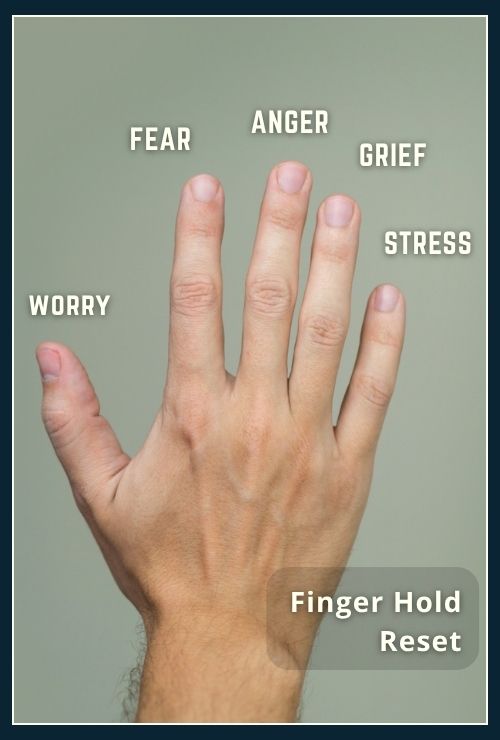
A hand showing what each finger represents in the Jin Shin Jyutsu Finger Holding Technique

Jin Shin Jyutsu Finger Holds

This is an old Japanese technique that’s simple and completely invisible to other people. You just hold one finger at a time with gentle pressure for a minute or two.
  • Thumb for worry and overthinking
  • Index for fear
  • Middle for anger and frustration
  • Ring for sadness or grief
  • Pinky for anxiety and that "Pretending I’m fine" stress
Do it on your daily commute or when ever time drags.  It feels more like a tactical reset than meditation.

Cold Reset (Temperature + Movement)

When things feel bad, use cold to interrupt it.
Splash cold water on your face, run your wrists under cold water for thirty seconds, or hold something cold like an ice pack or a chilled bottle.

Straight after that, do thirty seconds of hard movement.
That can be anything that fits where you are. Push against a wall, move quickly up a few steps, tense and release your fists, or press your feet firmly into the ground and hold.

You’re just giving your body a short burst so your head can reset.

Opposite Action Micro-Move

When your brain is telling you to stay in bed, avoid a call, or avoid something, start by writing down the situation quickly. List why you don’t want to do it, then list why doing it might actually be the right move. Look at both sides to see things more clearly.

Then just take one tiny opposite step. If you want to stay in bed, sit up on the edge for fifteen seconds. If you’re avoiding a call, pick up the phone and open the contacts. If you’re dodging a task, stand up and walk over to where it starts.

You don’t have to finish the whole thing - that one small move is often enough to get you back in control.

5-4-3-2-1 Grounding

If your mind is racing with what-if thoughts, this brings you straight back to the present. 

Name five things you can see right now, four things you can touch, three sounds you can hear, two things you can smell, and one thing you can taste. You can do the whole thing in under a minute at your desk, in the car, on the train, or anywhere else. 

Build A Mental Reset Toolkit That You Will Actually Use

Keep everything together in a small grab bag or a tough zip pouch so you can take it with you. The main rule is simple: only put in things that asolve a real problem for you. Nothing decorative.

Useful Men's Mental Reset Toolkit Items

  • Soft cloth and basic face wash - for a 30 seconds refresh.
  • Weighted eye mask - blocks light and gives calm pressure.
  • Earbuds with a short playlist of nature sounds.
  • A smooth stone or metal worry coin
  • Strong mints, chews, or dark chocolate
  • Small pocket notebook and pen - to jot down thoughts
  • A portable calf roller - to release tension in your legs.
Start with just three or four items. Try each one for a week. If you’re not reaching for it, ditch it and try something else.

Keep Your Mental Reset Toolkit Visible And Easy To Use

Carry the kit around with you as you go through the day. Leave it on your nightstand in the morning, move it to your desk when you’re working, and take it out to the car when you drive. 

That way you always know where it is, and seeing it reminds you to do something small for yourself. For travel it slips easily into a laptop sleeve. If you can’t find the kit, you won’t use it, so keep it with you.

How To Use Your Mental Reset Toolkit Every Day

Use the kit when you need to, not because you think you should.
Some days you won’t touch it. Other days you might use two or three things. That’s fine. The point is to have something to reach for.

Pick an item that fits the moment and use it for a minute or two, then move on. You’re not trying to build a routine around it or get it perfect. It’s just there to help you reset and get back to what you were doing.

If anything runs out, replace it the same day, that way the kit stays ready to use, 

Simple Habits That Stick For Mental Resets

Habit Stacking

The easiest way to get used to using your mental reset kit is to link it to moments that already happen in your day. You’re just giving yourself a reminder to reach into the kit when those moments come up.
After you close your laptop at the end of the day, eat a mint to break the work loop.
When you get home and drop your bag down, sit for a moment and use your calf massager. Before a difficult call, hold a smooth stone or small object to steady your focus. If you’re about to head out or start something new, jot a quick note to clear your head.

Keep It Going With A Simple Check Mark

Get yourself a paper calendar, or just print one out. Each day you use one of the tools, put a check mark in the box and leave it at that. No scoring, no targets. After a few days you’ll see the marks building up, and that’s usually enough to keep you going.
If you want to build a new habit, make the starting point so small it’s impossible to fail. Want to sit quietly? Just do it for sixty seconds. Want to move more? Walk to the end of the driveway. Once it becomes normal, it naturally grows from there.

Quick Daily Mental Check-Ins

End of Day Win
Before you go to bed, think of one small thing you handled that day. Just one win. It doesn’t have to be big. This helps stop your brain from only replaying all the things that went wrong.
Three-Point Body Check
Three times during the day, stop for thirty seconds. Ask yourself: How’s my breathing? How’s my posture? Where am I carrying tension? Then fix one of them. You can do this sitting at your desk or in the car.
One-Week Energy Log
For one week, make a quick note of the time and what you were doing when your energy drops or when you suddenly feel more alert. After a few days, you’ll start to notice patterns. Once you see them, you can step in earlier instead of getting caught off guard.

How To Keep Your Mental Reset Toolkit Simple And Useful

When you want to add something new to the kit, buy a cheap version first and test it for a week. If you actually use it, then keep it. And here’s a good rule: every time you add something, take out one old item that isn’t getting used. This stops the kit turning into a drawer full of junk you never touch.
These pair nicely with what you've just read
crosschevron-down