Why Expensive Grooming Products Are Not Always Better

Most people have at least one product they rate highly enough to keep buying without thinking twice. Most people have also wasted money on something that did nothing useful and ended up at the back of a shelf. What separated the two was not the price.

Why Expensive Products Feel Like They Should Work Better

Luxury Packaging Creates Expectations

We’ve all done it - picked a bottle of product from a shop shelf, felt the weight of it, and put it right back because it felt cheap. There was no need to read the ingredient list - the weight told you everything you needed to know. The thing is, weight is one of the easiest things to fake. A heavy glass bottle, a sleek pump, how cool it looks sitting on your bathroom shelf - none of this affects what the formula inside does to your hair or skin, but it absolutely affects how you feel about it before you have even used it.

Marketing Can Make Ordinary Products Feel Premium

Brands don't spend millions on celebrity campaigns out of kindness. When a product has a known face behind it, a big campaign, and a presence in every magazine, that costs money to put together. None of it goes into the formula. All of it goes into the price you pay at the till. That doesn’t mean it’s a bad product, it just means the price tag is covering more than what's in the bottle.
Fragrance, Texture And Presentation Influence Perception

You squeeze a small amount of expensive product into your palm - because the instructions always say a small amount - it smells extraordinary and spreads like silk. That experience alone makes you feel sure it’ll work before you've even used it. Now compare that with a product that has the same active ingredients but it smells of nothing and feels like water. Fragrance and texture cost money to get right and they do serve a purpose - a product that feels good to use is one you will actually use. Just don't confuse enjoying it with it working better than a basic product.

What The Ingredient List Actually Tells You

Active Ingredients Matter More Than Brand Names

Say you've picked up two scalp treatments - one expensive, one not. Both have salicylic acid on the label. Which one works better for your scalp depends entirely on how much salicylic acid is actually in each formula, not which one costs more. The label on the front won’t tell you which one has more, but the ingredient list on the back can give you a far better idea of what you're buying.

Ingredient Order Tells Its Own Story

Pick up any grooming product and flip it over. The ingredient list runs from the highest concentration to lowest, which means the first few ingredients are doing most of the work. For shampoos and moisturisers it's usually water followed by something that helps your skin or hair hold onto moisture or feel smoother. Doesn't matter if you paid £6.99 or £260 for it - the rules are the same. An ingredient that shows up after all the preservatives and fragrance isn't going to do anything useful for your hair or skin.

Ingredient Dusting Can Make Products Look More Impressive Than They Are

There's actually a name for this in the industry - ingredient dusting. It's how a shampoo gets to say keratin on the bottle and a serum gets to say hyaluronic acid. Trace amounts of those active ingredients are somewhere in the formula, just not enough to treat anything. Once you know that's a thing, you'll start reading labels very differently.

When Premium Products Genuinely Earn The Price

Better Formulations Can Improve Performance

A good example of this is SPF moisturisers. You put it on in the morning thinking your skin is covered for the day. But UV filters are not automatically stable - if the formula hasn’t been built to keep them working, the protection starts wearing off well before the day is done. It takes real development work to make it safe and long-lasting. When a brand has actually done it, a higher price is fair for a product you rely on to protect your skin.

Specialist Products Often Cost More For A Reason

Not every grooming problem has a cheap solution. If your hair has been battered by bleach or heavy heat, a bond-repair treatment with keratin and amino acids is worth the money, while a premium shampoo with nice packaging is not. That’s because the treatment is more potent than a basic product. The same goes for targeted treatments for a scalp that won't settle down, or skin that reacts to almost everything. The price on those reflects what went into making them work - they aren't premium purchases for the sake of it.

When A Cheaper Product Does The Same Job

Basic Products Often Deliver Similar Results

A face wash has one job - to clean your face. If your skin isn't particularly oily, not breaking out, not sensitive, then a £5 supermarket face wash will do the job just as well as one from a high-end brand. There is no premium ingredient that makes your face cleaner - it either removes dirt or it doesn't.

Paying More Does Not Guarantee Better Outcomes

Has this happened to you - the expensive shampoo runs out, you grab something cheaper to tide you over. Weeks later you expected to see your hair behaving badly, but you really couldn't tell the difference. For a lot of everyday grooming products, the gap between expensive and cheap is much smaller in reality than it looks on the shelf.

Your Hair And Skin Matter More Than The Price Tag

Your hair and skin are not going to respond to a product because it costs a lot. Two people can use the same expensive product and get completely different results. Hair type, skin type, water hardness and diet all matter more than the brand or price. The cheapest option on the shelf might be the one your hair has needed all along, while the most expensive one might do nothing for you at all.

How To Tell Whether A Product Is Worth The Money

Start With Your Needs Instead Of The Brand

Before you buy anything, get specific about what you want to fix. Whether it is dry hair or reactive skin, the problem has a particular kind of ingredient that deals with it. Shop with that in mind and ignore everything else. Most people do it the other way round; they find something that looks good and then work backwards to justify buying it. That approach will cost you more money and get you worse results than starting with the problem.
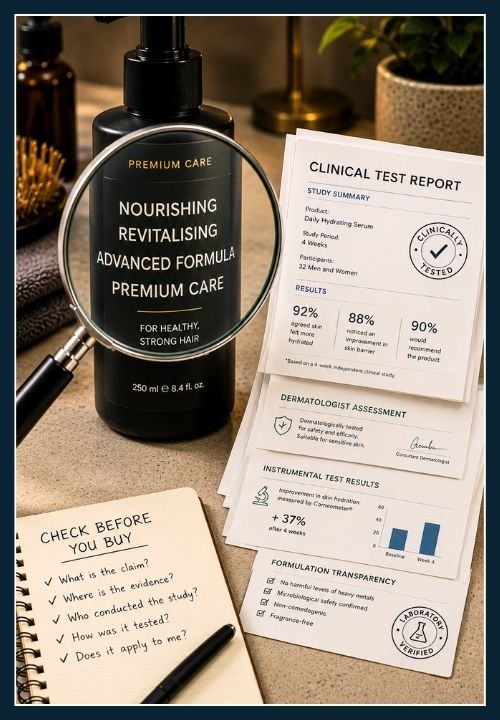
Close up of a grooming product bottle showing marketing claims alongside references to studies and product testing.

Look For Evidence Rather Than Claims

Words like nourishing and revitalising are on every bottle because nobody can be held to them. But, if a product says clinically proven and dermatologically tested, it should be able to point you toward the study and tests. Fragrance-free means nothing if the formula is full of botanical extracts that do the same job as fragrance on sensitive skin. The more concrete the claim, the more likely there is something real behind it.

Think About Cost Per Use

Before you decide something is too expensive, work out what it actually costs you to use. A £70 facial oil that lasts six months can work out cheaper than a £25 one you replace every six weeks. The number on the shelf is not what something costs you. How long it lasts and how much you go through per use is what determines that.
Take a look at these next:
crosschevron-down