How to Fall Asleep When Anxiety About Tomorrow Keeps You Awake

Anxiety about the next day can keep your mind active when you’re trying to sleep. It often follows the same pattern.

Why Anxiety About Tomorrow Keeps You Awake

You’re in bed, lights off, ready to sleep. Then your brain decides now is the perfect time to go through everything happening tomorrow.

Your Mind Starts Running Through Tomorrow

 You've got a long train or car commute, an important meeting, a catch-up with someone, or that thing you've been putting off - whatever it is, the thoughts won't stop.

"What if I mess up? What if I'm late again? What if they notice I'm a mess?" Next thing you know, your body’s tense, your heart’s ticking a bit faster, and sleep is nowhere. 

The clock doesn't care, it just keeps on moving from 2 a.m. to 3 a.m., then 4:30 a.m. before your body finally gives in.

The Next Day Gets Harder

At 6 a.m. your alarm goes off and you drag yourself out of bed feeling like an ancestor - you either stumble in late or just call in sick because it's all too much to deal with.

This happens to a lot of men: anxiety about tomorrow ruins sleep tonight, which wrecks tomorrow and leaves you even more worried and tired.

You can break it without forcing yourself to "Just calm down and relax". Read on for straightforward solutions that can help when your brain is stuck in overdrive.

Deal With The Thoughts Early

When the thoughts kick in, don’t let them sit there building momentum.

Write Everything Down Straight Away

Keep a notebook by the bed. As soon as the tomorrow thoughts start bubbling up, don't fight them. Dump them all into the notebook and don't leave anything out. Jot down the worries, to-dos, worst-case scenarios. It's not an essay, no one is going to check it so it doesn't need to be neat.

Then tell yourself: "That's noted. I'll handle it tomorrow." Now it is out of your head you can stop rehearsing it.

Set Up a Simple Wind Down Routine

Just a short routine that tells your body it’s time to switch off.  Do this within 1 hour of bedtime, so if bedtime is 11pm, start your routine after 10pm. Dim the lights (including your phone screen). Have a warm bath (a shower can work for some people while others find them too invigorating).
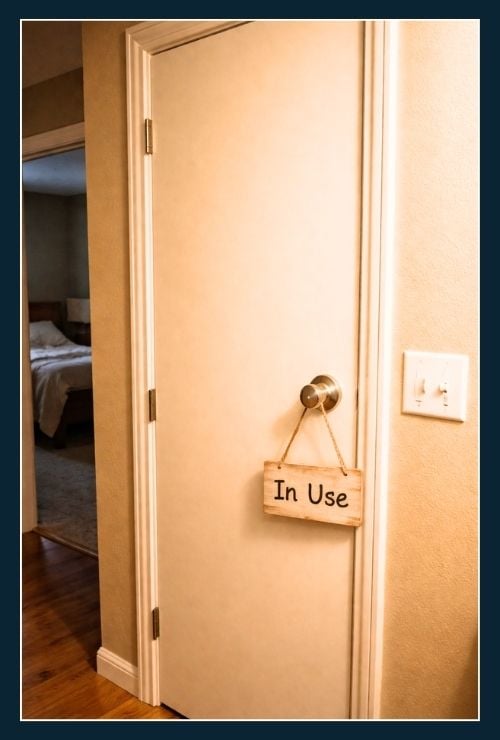
Toilet door in a home with a sign that says In Use.

Go To The Toilet (empty everything fully)

Low-level clenching around the lower abs and pelvis can keep your nervous system alert. Even if you don't feel desperate to go, make a proper trip to the loo. Empty your bladder and bowels completely. 

Once that's released, your whole body will relax easier because your muscles aren't working to hold anything in, so sleep can creep in faster.
A man lying comfortably on his back in bed with his hand placed on his belly. He is doing breathing exercoses

Do The Breathing Exercises Properly

Now lie down, hand on your belly. Breathe in slow through your nose for 5 seconds (belly rises), hold at the top for 5 seconds, then push out through your mouth for 8. Do 5 rounds. This will dial-down your nervous system.

Relax Your Muscles

Anxiety loves muscle tension, so take 5 minutes to loosen up as much as possible. Tense your toes hard for 5 seconds, release. Work up: calves, thighs, stomach, fists, shoulders, face. Take extra time with your shoulders - we all hold a lot of stress there.
A man lying on his side with a pillow placed comfortably under his head, supporting his neck. He has a pillow between his knees.

Use a Calmer Sleep Position

Sleep on your side, with your neck well supported by a proper pillow and put a pillow between your knees. This usually feels calmer than laying flat on your back. If you can avoid sleeping on your stomach - it can crank neck tension.

Try Sleep Aids If Needed

These sleep aids aren't magic, they work for some people and not others. So try one at a time until you find the one that makes a clear difference. If you're on meds speak to your doctor first.
  • Magnesium glycinate (200-400mg an hour before bed) - relaxes your muscles and quiets racing thoughts.
  • L-theanine (200mg) - this calms the “tired but wired” feeling.
  • Chamomile tea - gentle, no caffeine.
  • Ashwagandha (300-600mg) - dials down stress hormones over time.
  • Low-dose melatonin (0.5-3mg) - only works if your body clock is seriously off.

Fix The Pattern Long Term With  CBT-I

If you can't sleep because of anxiety (anxiety-driven insomnia), one of the first treatments you should try is Cognitive Behavioural Therapy for Insomnia (CBT-I).
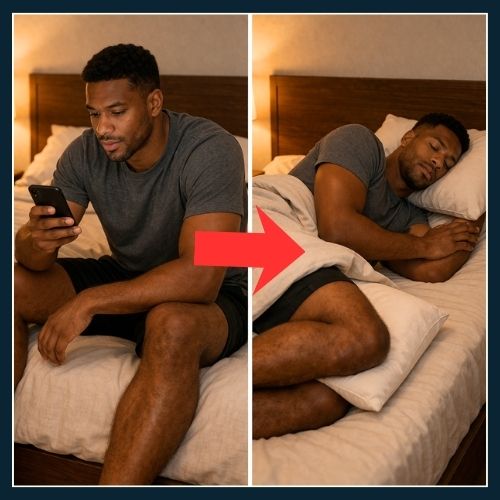
Split image: one side shows man scrolling while sitting on his bed. The other side shows the same man sleeping comfortably in bed. CBT-I helps to reset the brain to recognise that your bed is for relaxation only.

Understand WhatCBT-I Is Doing

It trains your mind to recognise your bed as a place for relaxation and sleep instead of a place for worrying thoughts. There are no pills or endless talking, just a few rules for you to stick to. You can see real improvements in a couple of weeks - and it lasts too.

Use Stimulus Control

Use the bed only for sleep (and sex). No scrolling, no worrying, no TV. If you’re not asleep in 15-20 minutes, get up, go to another room and do something boring and dim (read a dull book, fold laundry). Only go back to bed when you feel sleepy. Do this every single time. Sounds harsh but it breaks the "bed = frustration" link fast.

Use Sleep Restriction

For one week, jot down what time you roughly fell asleep and what time you woke up each morning. At the end of the week, look back and eyeball how many hours you were asleep on most nights. No need for the exact minutes, maybe it's 4 hours most nights.

Now pick a fixed wake-up time you can stick to every single day including weekends. That may be 6 or 7 a.m. if that's when you need to be up for work.

If you are getting about 4 hours sleep most nights and your wake up time is 6 a.m., your bedtime is 2 a.m. (If it's closer to 5 hours, bedtime at 1 a.m.)
Stick To The Core Rules
  • Don't go to bed any earlier than that, even if you're shattered.
  • Get up at your fixed time no matter what (set an alarm and get out of bed).
  • No naps during the day - they steal the tiredness you need at night.

Track Changes To Your Sleep

Stick to this for a week. Are you sleeping most of the time you're in bed (are you still tossing and turning or do you crash out completely)?

If you got solid sleep then go to bed 15-30 minutes earlier next week. If not then you can even shorten the window - go to bed 10 minutes later.

It's not forever - just until your body relearns how to sleep properly when you hit the pillow. If it feels way too rough (like dangerous sleepy during the day), ease up or talk to a doctor. But done this way, it's one of the strongest fixes for anxiety-about-the-future insomnia.

Change How You Respond To Thoughts

You don’t need to eliminate the thoughts. You want the thoughts to lose their grip so that your sleep improves naturally. When the thoughts about what poor sleep "will" do tomorrow surface - jot them down quickly (notebook by the bed again). Challenge them like this:
Thought
I'll never fall back asleep now - I'm doomed for the night.
Challenge:
I've woken up in the middle before and still got decent rest overall. My body usually drifts off again once I stop fighting.
Calmer swap
Even if I lie here a while, I'll get some sleep eventually, so it's not all or nothing.
Thought
If I don't get at least 7 hours, tomorrow  I'll mess up at work and everything falls apart.
Challenge:
I've survived rough nights before and still got through the day okay. The worst is usually just feeling a bit groggy, not the end of the world.
Calmer swap
Less sleep sucks, but I've handled it in the past. I'll do what I can tomorrow and it won't ruin everything.
Thought
This insomnia means something's seriously wrong with me - it'll never get better.
Challenge:
Lots of people go through times like this and improve with small changes. It's not permanent.
Calmer swap
This is temporary. I'll stick to these steps to help it ease up.

Extra Options That Help To Calm Your Mind

If you want a bit more support, these can help settle the internal noise.
a man lying in his bed with headphones on listening to audio hypnotherapy for better anxiety management.

Use Audio Support

Many men also find hypnotherapy-style audio really helps to reset the inner chat. It works by interrupting the constant “what if” loop and replacing it with calmer patterns that your mind starts to follow instead.

Over time, this can make those late-night thought spirals less intense and easier to step away from when you’re trying to sleep.

Years ago our editor used Marisa Peer's Uncompromised Life programme and her sleep tracks to help quiet the constant thoughts at night.
Split image top half shows a table full of processed and preserved packaged foods with high levels of sugar and grains. The second half shows unprocessed green food that resets your system.

Look At Food and Stress Balance

One programme that has helped thousands of men including our editor, is Wildfit by Eric Edmeades, which uses Marisa Peer’s hypnotherapy.

It works by sorting blood sugar, cortisol and stress hormones without relying on willpower. After about 2 weeks, the new habits start to feel normal and the “I need something to calm down” feeling fades. It’s meant to be three months, but lots of people stay on it much longer because the changes stick.
Definitely worth a look if anxiety is ruining your sleep.

Consider Using Guided Therapy

Some people prefer a more structured approach to working through the worry loop, especially when the same thoughts keep showing up night after night.

NLP + Hypnotherapy – A blend of neuro-linguistic programming and hypnotherapy by experienced professionals has helped a number of users quiet the worry loop more quickly by changing how those thoughts are processed in the first place.
crosschevron-down