Why Do My Joggers Always Pull at the Knees?

It's not your imagination, and it's not just you. If your knees curve in or out, every pair of joggers seems to fight you. They pull tight in one spot and bunch up in another. Let's fix that. This is how to find (and tailor) athleisure that fits bow legs, knock knees, or uneven legs.

Why Joggers Pull at the Knees With Bow Legs

What’s Happening

Your lower legs curve outward, but most joggers are cut for straighter legs
  • Straight joggers: They'll be tight on your outer thigh and very loose on the outer calf and the inside of your legs.
  • Baggy joggers: There's excess fabric which causes unflattering creases and bunches of fabric everywhere.
  • Tapered joggers: They'll be loose on your outer thighs and pull around your lower leg.

Jogger Fits That Work For Bow Legs

You need pants that follow the shape of your legs from hip to ankle.

Straight leg joggers may be the easiest to fit on bow legs. 

You'll need to try on a few to find a pair that doesn't pull across your outer knee. 

Make sure the joggers are made of strong fabric that won't get stretched out of shape. If you want to get really suave, a good athleisure tailor can make custom joggers that fit your exact shape.
Bow Legs - What to Look For

  • Look for 'Straight Leg' or 'Relaxed' joggers: These are the main ones to try. They're the same width from your thigh to your ankle, so they don't pull across your knee.
  • Get heavier fabric: Don't buy thin, stretchy material that acts like a second skin. Go for something thicker like canvas, heavy cotton, or fleece. It holds its shape and doesn't cling to your leg's curve.
  • But make sure it still stretches: Even that thicker fabric should have a little spandex in it (2-4%). You need that so you can move comfortably.
  • Texture is a bonus: Brushed or ribbed fabric is good. It adds a bit of visual distraction that makes the pants' line look less obvious.

Bow Legs - Tailoring Talk

Here’s what to ask for: "My knees bow out. Can you let out the outer seam of the legs so the fabric doesn't pull tight across my lower thigh and knee? I need it to hang straight."
What that does: It stops the fabric from pulling tight on the outside of your knee. The pants will hang straight down from your thigh instead of stretching across the leg curve.
What to expect:
Cost: About £20 to £40.
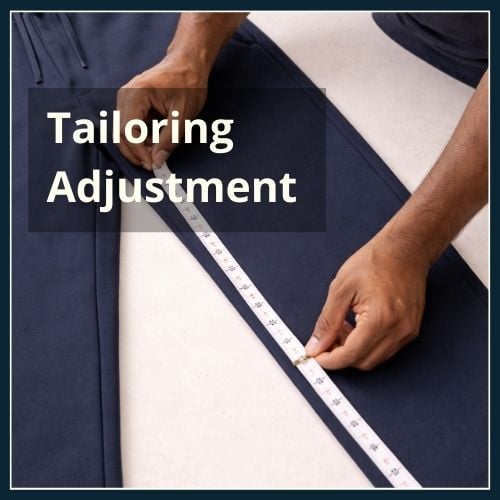
The Process: This is a more involved alteration. They'll likely open the outer seam from the hip to near the ankle, let out any spare fabric, and re-stitch it with a slight outward curve. They should have you stand and walk to check the new drape.

Why Joggers Bunch With Knock Knees

What’s Happening

Your knees angle inward and touch or come close together. 

This makes the fabric on the inner side of your legs (from your knees down to your calve) bunch up and wrinkle. 

The pants look like they're collapsing inward towards your body.

Jogger Fits That Work For Knock Knees

You need to avoid any pant that is tight through the knee. Look for straight-leg styles or relaxed fits that don't taper in. These give the fabric a clear path to hang down without being forced into the angle of your knee.

Knock Knees - What to Look For

  • Get 'straight leg' joggers: This is the most important rule. Don't buy anything that says "tapered" or "slim."
  • Make sure they have stretch: The fabric needs some spandex in it (look for 5-10% on the label). This lets the material give a little around your knee instead of pulling.
  • Don't buy thick, stiff denim: Heavy canvas or rigid denim will be uncomfortable and fight your leg's shape every time you move.
  • If you want a pattern, keep it simple: A very faint vertical stripe can help. It draws the eye up and down, not in and out.

Knock Knees - Athleisure Tailoring Talk

Here’s what to ask for: "My knees point inward, and my pants always bunch up on the inside of my calves. Can you fix them so they hang straight down from my knee?"
What that does: It removes the extra fabric that crumples on the inside of your calf. This helps the pants hang in a straighter line from your thigh to your ankle.
What to expect:
Cost: About £20 to £40.
The Process: They will pin the inner seam (the inseam) from below your knee to your ankle. They should have you stand with your feet together and then walk to make sure the new seam is comfortable and doesn't pull when your knees are close.

Why Joggers Twist With Uneven Legs

What’s Happening

One of your legs is slightly longer than the other. 

Most people wouldn't notice, but your clothes do. One pant leg will always twist, bunch at the ankle, or drag on the ground, while the other fits fine. This throws off your stride and can make you feel lopsided.

How To Balance Joggers For Uneven Legs

You've got two simple choices here. First, you can adjust the pants themselves so each leg is a different length. 

Second, you can level yourself out by putting a small lift in the shoe on your shorter side. Both ways make your pants hang straight.

Uneven Legs - What to Look For

  • Buy joggers with an adjustable hem: Look for toggles on the cuffs or a raw, unfinished hem. You can set the left and right leg to different lengths.
  • Pick thicker, softer fabrics: Choose mid-weight cotton or fleece. Thin, stretchy material will cling to your legs and make the length difference obvious.
  • Try a shoe lift first: Put a small insert (1-3 cm) in the shoe on your shorter side. It evens out your stance, so you can wear joggers straight off the rack.
  • Go for a straight or relaxed fit: These styles have more room. They're less likely to twist or pull tight on your longer leg, which can make the problem worse.

Uneven Legs - Athleisure Tailoring Talk

Here’s what to ask for: "Can you hem one leg longer than the other? One of my legs is shorter, and I need the pants to hang evenly at my ankles."
What that does: It makes the hem of each pant leg hit your ankle at the same point, so the pants look straight and balanced when you're standing.
What to expect:
Cost: About £15 to £30.
The Process: They'll measure each leg separately while you're standing normally. They should have you walk a few steps after pinning to make sure the new lengths don't cause twisting or pulling when you move.
These might answer your next question
crosschevron-down